


KAMPALA
Victoria University has strengthened its position among Uganda’s leading higher education institutions, ranking second nationally with 87.4 points as it holds its 10th graduation ceremony at Speke Resort Convention Centre in Munyonyo.

The two-day ceremony, running Monday and Tuesday under the theme “The Future Is Here,” has brought together graduands, parents, guardians, academic staff and invited guests to celebrate years of academic achievement.
The university expects to graduate about 2,500 students during the two days, marking another milestone in its growth since its establishment in 2013.
Monday’s session covers graduands from the Faculty of Science and Technology and the Faculty of Health Sciences, while Tuesday’s ceremony will feature those from the Faculty of Business and Management and the Faculty of Humanities and Social Sciences.
The graduation comes shortly after the National Council for Higher Education (NCHE) placed Victoria University second in its Revised Institutional Ranking Report, with 87.4 points, behind Makerere University, which scored 88.9 points.
Kampala International University followed in third place with 85.8 points, according to the report.
NCHE classified Victoria University in the “Leading” performance category, recognising its performance across several indicators used to assess the strength and relevance of higher education institutions.
The assessment considered seven weighted dimensions, including enrolment vibrancy, programme viability, graduate training strength, gender balance, participation in science, technology, engineering and mathematics (STEM), female participation in STEM and curriculum relevance.

14,113 Students, 66 Programmes
The report’s detailed figures show that Victoria University has 14,113 students enrolled across 66 academic programmes, representing an average of 128.7 students per programme.
Female students account for 50.1 per cent of the total enrolment, while STEM programmes attract 52.7 per cent of the student population.
Women make up 49.2 per cent of students enrolled in STEM programmes, highlighting the university’s participation levels in science and technology-related fields.
The ranking comes as the institution celebrates its 10th graduation ceremony, offering an opportunity to reflect on its academic expansion and contribution to Uganda’s education sector and workforce.

University officials have consistently emphasised the importance of technology-oriented and market-relevant courses in preparing graduates for an increasingly competitive job market.
AI Takes Centre Stage
Julius Bukyana, the university’s corporate and public relations manager, said the graduation theme reflects the growing influence of technology and artificial intelligence on education and the workplace.
Bukyana noted that the nature of work was changing, requiring universities to equip students with practical skills and the ability to adapt as new technologies are adopted across industries.
The university has also highlighted its training model, which combines classroom learning with workplace placements to prepare students for employment opportunities in Uganda and abroad.
The approach is intended to bridge the gap between academic knowledge and the practical demands of employers.
Ruparelia Group Credited for Growth
Jay Sakaria, vice chairperson of the university council, and Meera Ruparelia, a member of the board of directors, are representing businessman Dr Sudhir Ruparelia, chairman of the Ruparelia Group, which owns Victoria University.
Vice Chancellor Prof. Lawrence Muganga thanked Dr Ruparelia and the Ruparelia Group for their support in the institution’s growth.
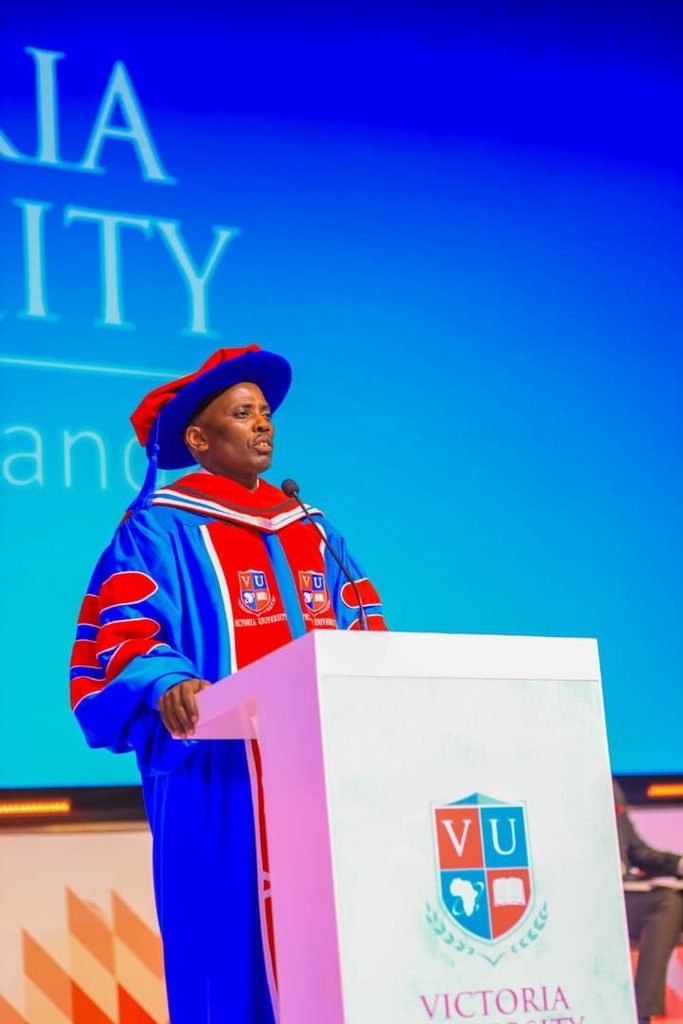
Victoria University was established in 2013 and is a chartered private university. Its main campus is located at Victoria Towers along Jinja Road in Kampala.
The institution held its ninth graduation ceremony at Speke Resort Convention Centre in October 2025.
As the university celebrates its latest batch of graduates, its second-place NCHE ranking places renewed attention on its enrolment, STEM participation and efforts to align academic training with the demands of a changing labour market.