
Journalism Is Not a Crime’: Alipoota Sounds Alarm Over Alleged Attempt to Silence Press
By Alipoota
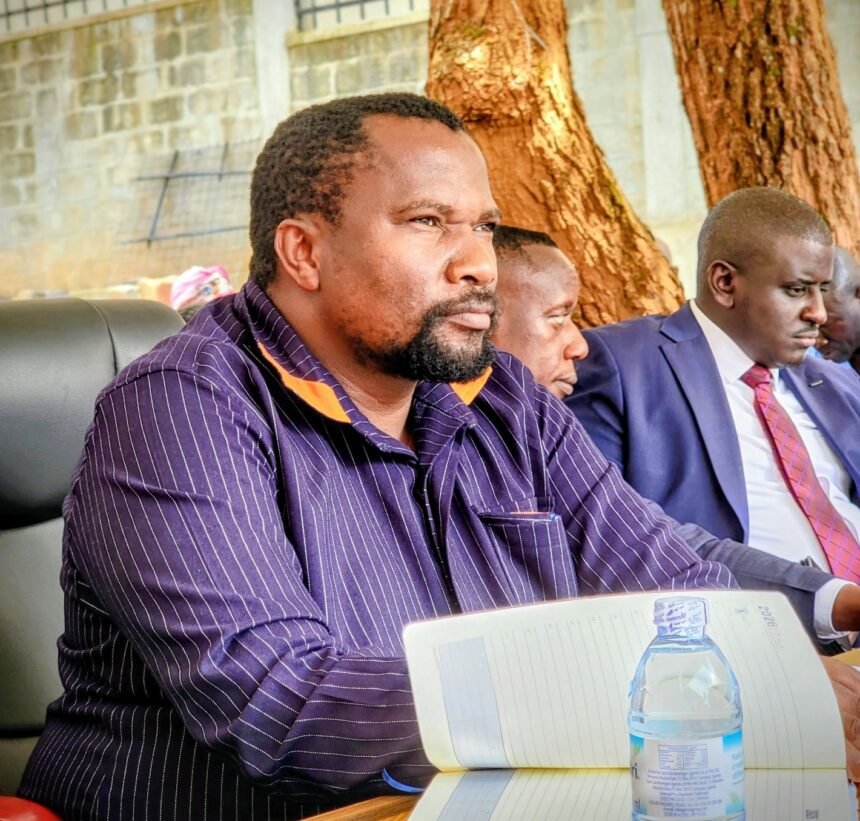
Alipoota has raised the alarm over what it describes as a troubling attempt to undermine press freedom after its was served with a warning demanding the removal of published material and restrictions on future publication concerning Special Presidential Assistant on Service Delivery and Monitoring,Yiga Kisakyamukama.
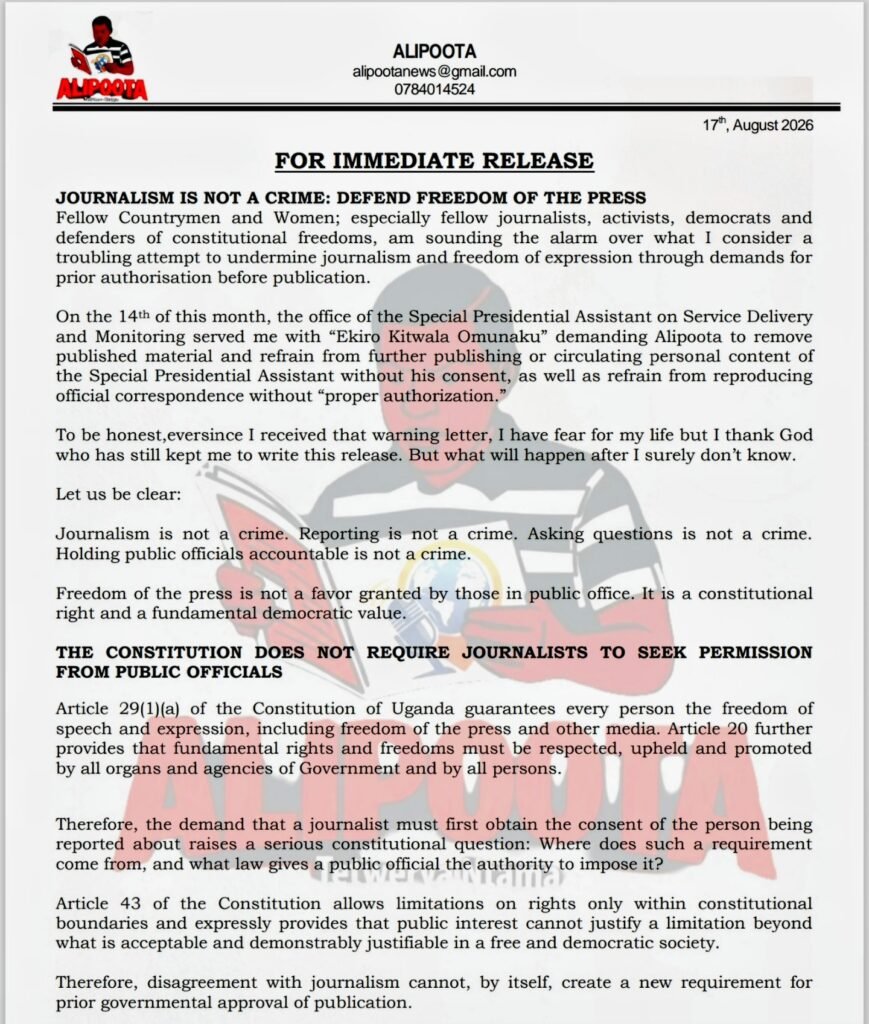
In a strongly worded statement, Alipoota said the warning letter(Ekiro Kitwala Omunaku), served on August 14, demanded that the platform remove published material and refrain from publishing or circulating personal content concerning Kisakyamukama without his consent.
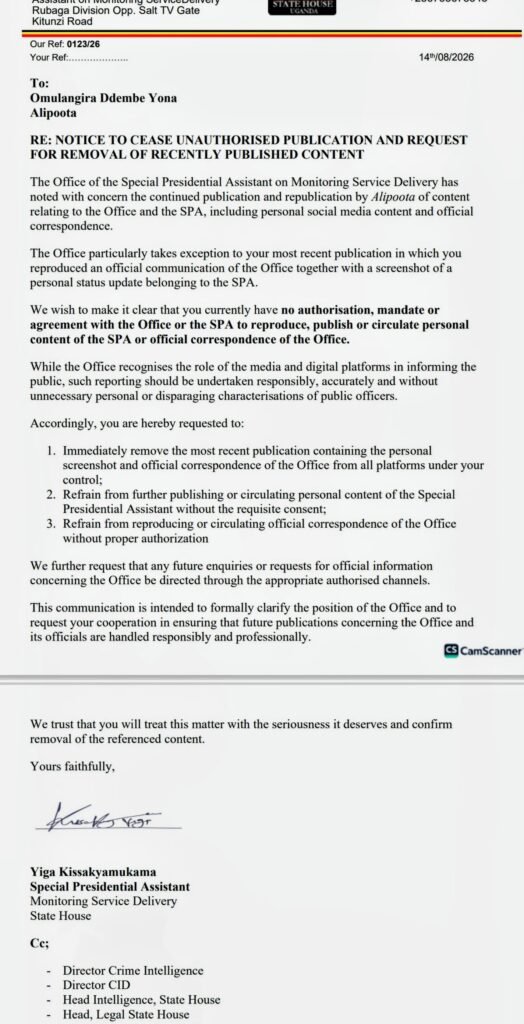
The communication also reportedly demanded that official correspondence should not be reproduced without “proper authorization.”
The development has left the Alipoota team concerned about the wider implications for journalism and freedom of expression in Uganda.
“To be honest, ever since I received that warning letter, I have fear for my life, but I thank God who has still kept me to write this release. What will happen after this, I surely don’t know,” the editor said.
‘Journalism is not a crime’
The statement insists that reporting, asking questions and holding public officials accountable cannot be treated as criminal acts.
“Journalism is not a crime. Reporting is not a crime. Asking questions is not a crime. Holding public officials accountable is not a crime,” the statement reads.
Alipoota argues that freedom of the press is not a favour granted by public officials but a constitutional right.
The platform cites Article 29(1)(a) of the Constitution, which guarantees freedom of speech and expression, including freedom of the press and other media.
It also points to Article 20, which requires fundamental rights and freedoms to be respected, upheld and promoted by government organs, agencies and individuals.
The central question raised by Alipoota is therefore straightforward: What law requires journalists to obtain permission from a public official before publishing information concerning that official?
Right to information
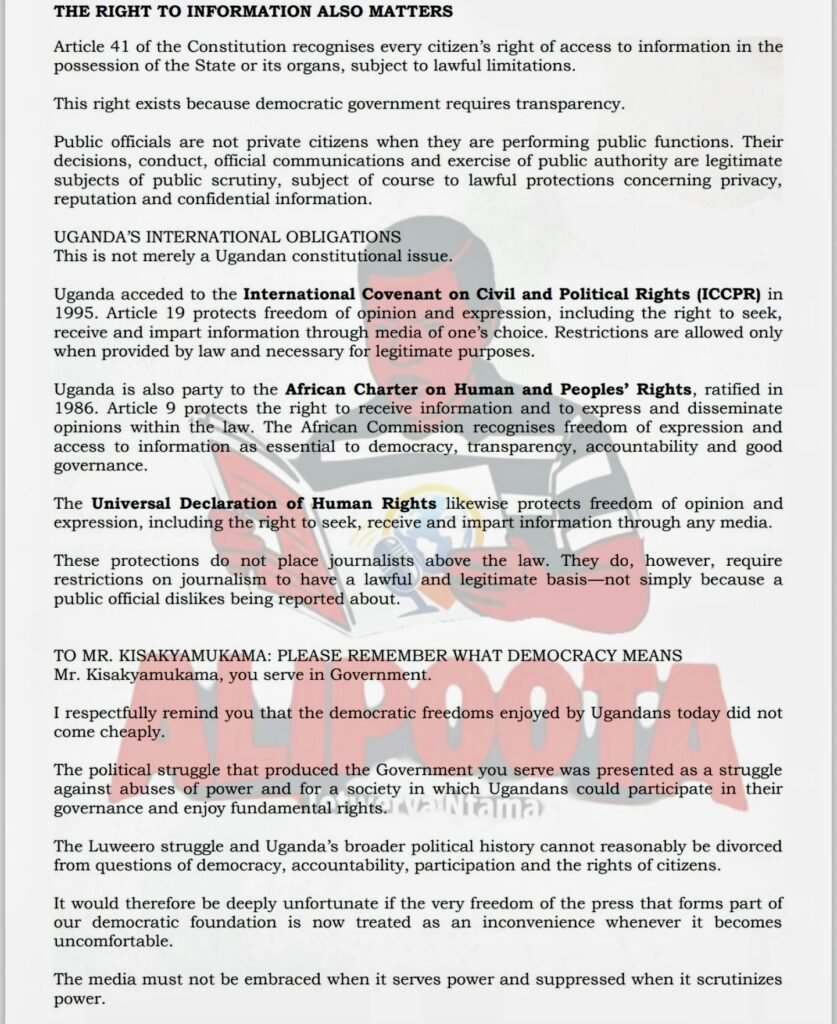
Alipoota also invoked Article 41 of the Constitution, which recognises citizens’ right of access to information in the possession of the State or its organs, subject to lawful limitations.
The statement argues that public officials performing public functions should reasonably expect their decisions, conduct, official communications and exercise of public authority to face public scrutiny.
However, Alipoota acknowledges that journalism is not without limits.
The platform says journalists must respect lawful protections relating to privacy, reputation, confidential information and other legitimate restrictions.
‘The publication was not made in bad faith’
Alipoota has also made an important clarification regarding the disputed publication.
The platform maintains that the article was not published in bad faith, with malicious intent or with the intention of deliberately harming Kisakyamukama’s reputation.
According to the statement, the publication was made in the course of journalism and public-interest reporting, based on information available to the platform at the time.
Alipoota says that agreeing to remove the particular publication was an act of goodwill and an attempt to resolve the disagreement peacefully. It was not an admission that the article was unlawful, defamatory or published in bad faith.
The platform says that where a genuine factual error is identified, it remains prepared to correct it through responsible journalistic practice.
International protection
The statement further argues that Uganda’s obligations extend beyond its Constitution.
Uganda is a party to the International Covenant on Civil and Political Rights, whose Article 19 protects freedom of opinion and expression, including the right to seek, receive and impart information.
Uganda is also party to the African Charter on Human and Peoples’ Rights, whose Article 9 protects the right to receive information and express and disseminate opinions within the law.
Alipoota’s position is that these protections do not place journalists above the law, but require restrictions on journalism to have a lawful and legitimate basis.
Message to Kisakyamukama
Addressing Kisakyamukama directly, Alipoota urged the public official to remember the importance of democratic freedoms.
The statement argues that Uganda’s political history, including the Luweero struggle, has been presented around issues of political participation, accountability and resistance to abuses of power.
It would therefore be unfortunate, the platform argues, if press freedom became acceptable only when journalism supports those in power.
“The media must not be embraced when it serves power and suppressed when it scrutinizes power,” the statement says.
‘The media is not an enemy’
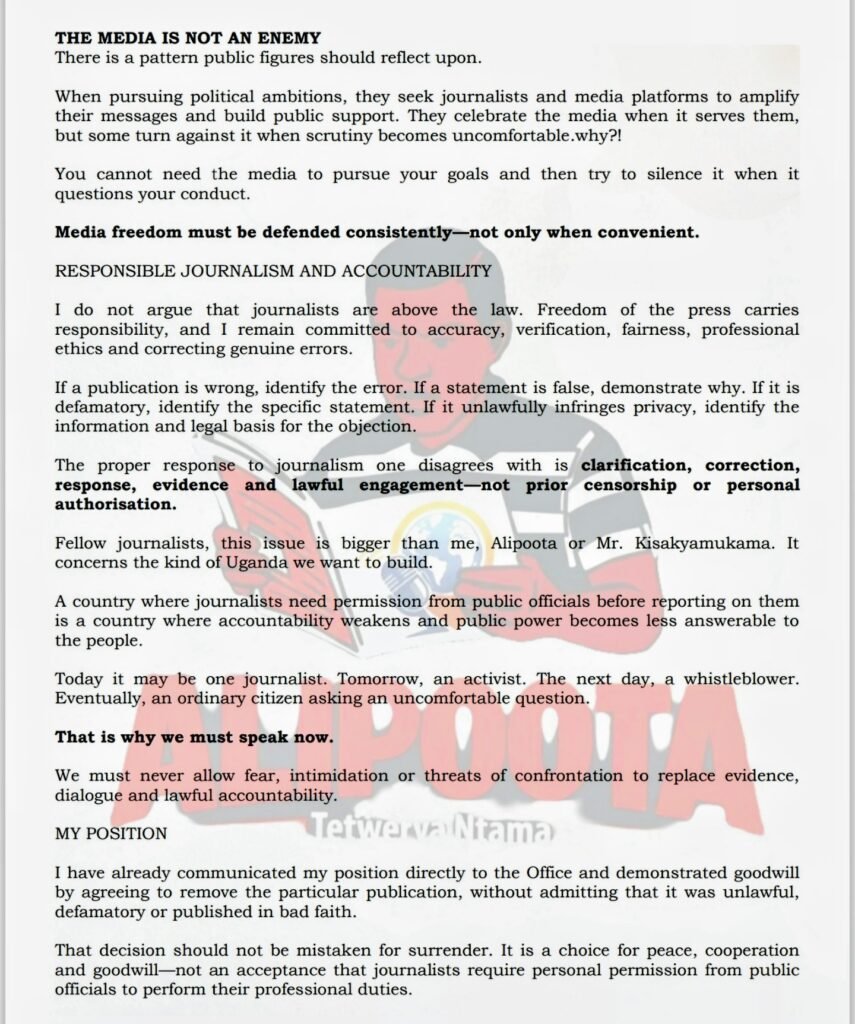
Alipoota also questioned what it described as a recurring political contradiction: public figures often seek journalists when they need publicity, but become hostile when the same media platforms begin asking difficult questions.
“You cannot need the media to pursue your goals and then try to silence it when it questions your conduct,” the statement argues.
The platform maintains that media freedom must be defended consistently, whether coverage is favourable or uncomfortable.
Alipoota accepts responsibility
Importantly, the platform says it does not claim journalists are above the law.
It pledges to uphold accuracy, verification, fairness and professional ethics, while correcting genuine mistakes.
If a story is inaccurate, the platform says, the specific error should be identified. If a statement is allegedly false or defamatory, the complainant should point to the particular statement and provide a lawful basis for the objection.
Alipoota says the appropriate response to disputed journalism should be clarification, correction, evidence, a right of response and lawful engagement—not prior censorship or personal authorisation.
‘Removal was not surrender’
The platform says it has already demonstrated goodwill by agreeing to remove the particular publication at issue.
However, Alipoota stresses that this decision was not an admission of wrongdoing or an acknowledgment that the publication was unlawful, defamatory or made in bad faith.
Instead, it was a deliberate choice to prioritise peace, cooperation and constructive engagement.
“That decision should not be mistaken for surrender,” the statement warns.
Alipoota says it remains willing to correct genuine errors and engage constructively with public institutions, but insists such engagement must never become a mechanism for controlling journalism.
A warning to Uganda
Alipoota has called upon journalists, media houses, lawyers, activists, civil society organisations and defenders of democracy to remain vigilant.
The platform argues that the issue extends beyond one journalist, one media organisation or one government official.
“Today it may be one journalist. Tomorrow, an activist. The next day, a whistleblower. Eventually, an ordinary citizen asking an uncomfortable question,” the statement says.
The message is ultimately a call for dialogue and lawful accountability rather than intimidation.
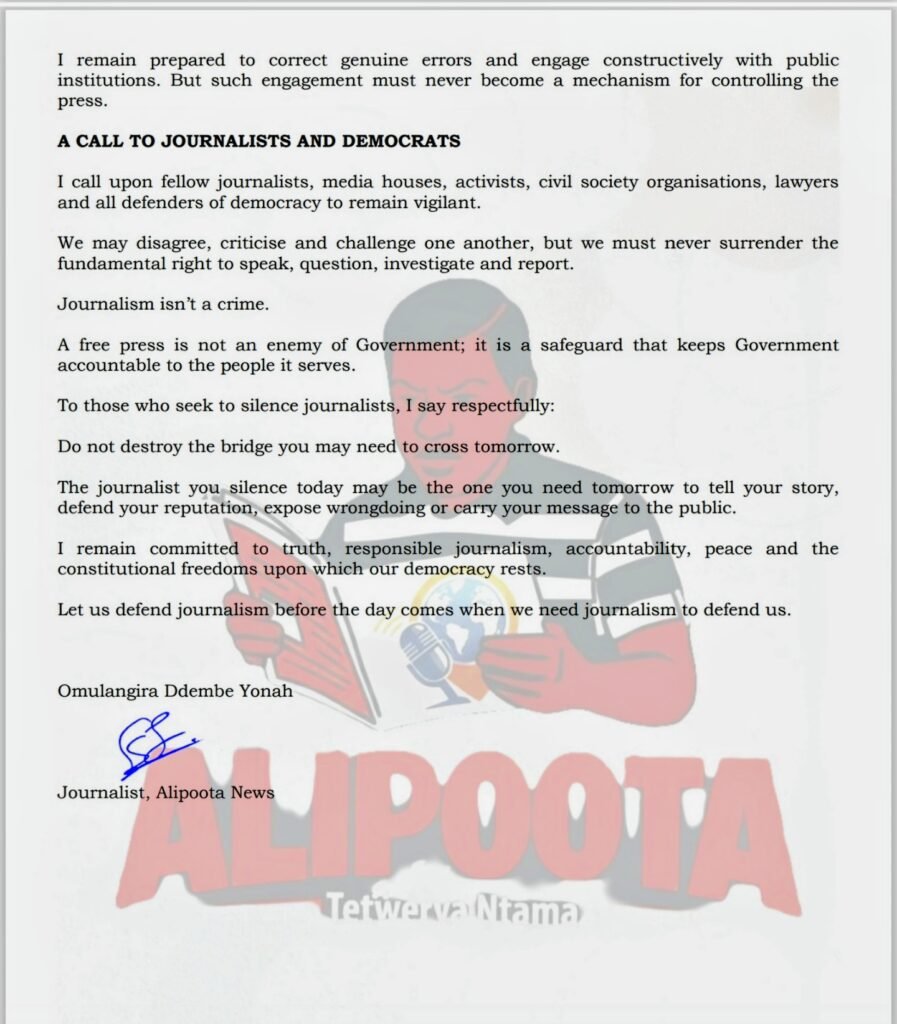
“Journalism isn’t a crime. A free press is not an enemy of Government; it is a safeguard that keeps Government accountable to the people it serves.”
And in its final appeal, Alipoota delivers a warning to those who may seek to silence the press:
“Do not destroy the bridge you may need to cross tomorrow.”
The platform says it will remain committed to truth, responsible journalism, accountability, peace and the constitutional freedoms upon which Uganda’s democracy rests.